


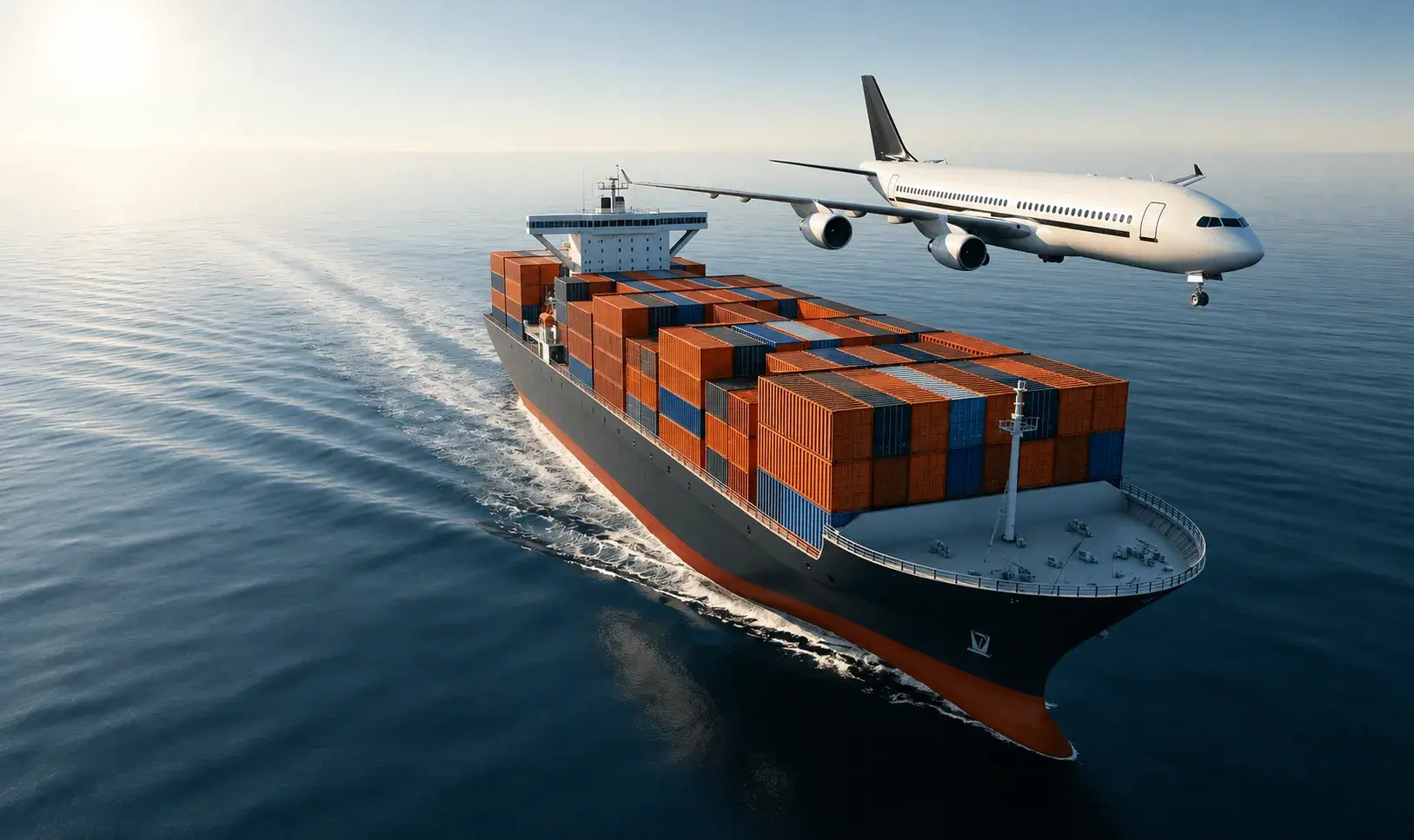

Air and Ocean Freight: The Decision That Protects Your Company’s Time, Space, and Capital
A shipment does not begin its journey when it is loaded onto an aircraft or placed inside a container. Its journey starts much earlier, when a company decides how much inventory to purchase, when it needs that inventory, and how much capital it can keep tied up in transit.
That is why choosing between air and ocean freight is not simply a matter of comparing which option is faster or which one offers the lowest freight rate. The real decision is determining which mode of transportation best protects three essential business resources:
- Available time.
- The space occupied by the cargo.
- The capital invested in inventory.
A poor decision can lead to stock shortages, emergency purchases, unnecessary storage expenses, lost sales, or cargo remaining in transit longer than expected. A well-planned decision, however, can turn international transportation into a competitive advantage.
In this guide, we will explain how to choose the right transportation method according to the actual characteristics of each shipment and when it may be beneficial to combine both options.
What Is the Real Difference Between Air and Ocean Freight?
The most obvious difference is the mode of transportation. Air cargo travels by aircraft, while ocean cargo moves aboard container ships.
From a business perspective, however, the most important difference is how each transportation method manages time, volume, and cost.
Air Freight Buys Time
Air freight is particularly useful when speed has a direct impact on business operations.
It may be suitable for:
- Replenishing inventory that is about to run out.
- Transporting high-value products.
- Fulfilling urgent customer orders.
- Importing commercial samples.
- Moving essential spare parts.
- Shipping small or medium-sized cargo.
- Responding quickly to changes in demand.
Air freight should not be considered only as a more expensive alternative. In certain situations, paying for speed can prevent considerably greater losses.
Ocean Freight Makes Better Use of Space
Ocean freight makes it possible to transport larger and heavier cargo under a cost structure that is often more suitable for planned operations.
It may be appropriate for:
- Scheduled inventory replenishment.
- Raw materials.
- Equipment and machinery.
- Furniture and bulky products.
- Goods without an immediate delivery deadline.
- Recurring commercial imports.
- Cargo that can be consolidated.
Ocean freight becomes especially valuable when a company understands its demand and can anticipate its future inventory needs.
The Decision Is Not Simply “Fast Versus Affordable”
Focusing only on speed and price can lead to an incomplete decision.
An ocean shipment with an attractive freight rate may become expensive if it arrives after the company has already run out of inventory. Similarly, sending large, non-urgent merchandise by air may unnecessarily reduce profit margins.
The right question is not:
Which transportation method costs less?
The right question is:
Which option produces the best overall result for this specific operation?
The Three-Variable Rule: Clock, Cube, and Cash
To compare air and ocean freight effectively, companies should evaluate three essential variables. These can be represented by the clock, the cube, and the cash.
The Clock: What Is the Value of Arriving on Time?
The clock represents the actual urgency of the shipment.
Not every shipment that appears urgent is truly urgent, and not every delay has the same financial impact. A company should first calculate what will happen if the goods arrive later than expected.
Questions to Measure Urgency
- Will the company lose sales if the merchandise does not arrive on time?
- Is there a scheduled product launch?
- Does the cargo contain a spare part required to restart an operation?
- Has the company made delivery commitments to customers?
- Does the product have a short commercial season?
- Will the current inventory last until the new shipment arrives?
When a delay threatens business continuity, air freight may be the most efficient option, even when the initial freight cost is higher.
The Cube: How Much Space Does the Cargo Occupy?
The cube represents volume.
In logistics, weight is not the only factor that matters. The amount of space occupied by the merchandise is also important. A large but lightweight item can generate a significant charge because of its volumetric weight.
Volume Can Change the Decision
Imagine two shipments:
- A small box containing high-value electronic components.
- Several large boxes containing lightweight products with a low profit margin.
Although both shipments may have a similar actual weight, they should probably not be transported in the same way.
The first shipment may benefit from air transportation. The second may achieve a more suitable cost structure through ocean freight.
Before requesting a quotation, it is advisable to know:
- Actual weight.
- Length.
- Width.
- Height.
- Number of packages.
- Type of packaging.
- Whether the cargo can be stacked.
- Whether the products are fragile.
A quotation based on incomplete information may change once the cargo is received, measured, and inspected.
The Cash: How Much Capital Can Remain in Transit?
Cash represents the company’s financial flow.
When a business purchases inventory, its money remains tied up until the goods arrive, clear customs, enter storage, and are eventually sold. The longer this cycle takes, the longer the company must wait to recover its investment.
The Hidden Cost of Inventory in Transit
Consider a company importing high-turnover products. Ocean freight may offer a lower transportation cost, but it also requires more planning.
When the company does not have enough backup inventory, it may experience:
- Stock shortages.
- Lost sales.
- Emergency purchases.
- Dissatisfied customers.
- Cash-flow pressure.
- Additional storage or correction expenses.
For this reason, logistics costs should be analyzed together with inventory value, sales velocity, and the company’s financial capacity.
When Should You Choose Air Freight?
Air transportation is often appropriate when time is more valuable than the savings obtained through a slower shipping method.
High-Turnover Products
When a product sells quickly and there is a risk of running out of inventory, an air shipment can protect sales while a larger order is transported by ocean.
Critical Spare Parts
A small component can shut down a machine, vehicle, production line, or entire business process.
In such cases, the freight cost may be minimal compared with the cost of keeping the operation stopped.
High-Value, Low-Volume Merchandise
Technology components, specialized devices, samples, instruments, and compact products can make better use of the available air cargo space.
Product Launches and Commercial Seasons
When the merchandise must be available for a promotion, trade show, seasonal campaign, or specific date, transit time becomes a major priority.
Small Orders or Market Tests
Before importing large quantities, a company can use air freight to test customer demand, reduce initial risk, and obtain real market data.
Main Advantages of Air Freight
- Faster transit.
- Frequent departures on certain routes.
- Suitable for small shipments.
- Effective for emergencies.
- Less time with inventory in transit.
- Faster inventory replenishment.
Important Factors to Review
- Actual and volumetric weight.
- Cargo restrictions.
- Required documentation.
- Product value.
- Packaging.
- Special permits.
- Import-related costs.
When Should You Choose Ocean Freight?
Ocean freight is usually the strategic choice when the operation can be planned in advance and volume has a significant influence on transportation cost.
Large or Heavy Merchandise
Equipment, furniture, construction materials, merchandise packed in multiple boxes, and larger commercial shipments often benefit from ocean transportation.
Scheduled Inventory Replenishment
Companies that understand their sales cycles can organize purchases in advance and use ocean freight to maintain a sustainable logistics structure.
Products With Limited Profit Margins
When transportation represents a significant portion of the final sales price, reducing the cost per unit may be essential for preserving profitability.
Consolidated Purchases
When a company purchases from several suppliers, cargo consolidation can make it possible to combine merchandise into one operation, provided that proper coordination is arranged at the point of origin.
Projects Without Immediate Urgency
Remodeling projects, business openings, equipment replacements, and scheduled supply operations can be organized early enough to benefit from ocean transportation.
Main Advantages of Ocean Freight
- Capacity for larger volumes.
- Consolidated cargo alternatives.
- Suitable for heavy merchandise.
- Ability to transport different cargo types.
- Better cost distribution for larger purchases.
- Useful for planned inventory management.
Important Factors to Review
- Total operation time.
- Port of origin and destination.
- Space availability.
- Departure schedules.
- Type of consolidation.
- Documentation.
- Port and customs expenses.
- Final delivery after arrival.
LCL and FCL: Two Types of Ocean Freight
Ocean transportation includes several service options. Two of the most common are LCL and FCL.
What Is LCL Cargo?
LCL means Less than Container Load. Under this model, the shipment shares container space with cargo belonging to other customers.
This option may be useful when the shipment volume does not justify booking a full container.
Possible Advantages of LCL
- Suitable for medium-sized shipments.
- Avoids paying for an entire container.
- Supports recurring imports of smaller volumes.
- Can adapt to growing companies.
What Is FCL Cargo?
FCL means Full Container Load. It refers to the use of an entire container for a single customer or shipment.
It may be suitable when the merchandise occupies a significant portion of the container or when the nature of the cargo requires greater control over the available space.
Possible Advantages of FCL
- Exclusive use of the container.
- Greater cargo capacity.
- Less shared handling.
- Suitable for high-volume operations.
- Better planning for recurring imports.
The choice between LCL and FCL should be based on volume, weight, cargo characteristics, frequency, and total cost.
The Hybrid Strategy: One Part Flies and the Other Sails
One of the most efficient solutions may not involve choosing only one transportation method.
Many companies can achieve better results by dividing their purchase between air and ocean freight.
How Does It Work?
A small portion of the inventory is transported by air to meet immediate demand. The remaining merchandise travels by ocean to reduce the average cost of the overall operation.
Practical Example
A retailer needs 500 units of a product before an important commercial season, but its current inventory will only last for two more weeks.
Instead of sending all 500 units by air or waiting for the entire order to arrive by ocean, the company could:
- Transport 80 units by air.
- Ship the remaining 420 units by ocean.
- Continue selling while the main inventory shipment is in transit.
- Reduce the total cost compared with sending the entire order by air.
When Can This Strategy Work?
- When inventory is close to running out.
- When there is immediate customer demand.
- When the full order is bulky.
- When part of the merchandise is more urgent.
- When the supplier can divide the shipment.
- When the product margin can support a partial air shipment.
This approach requires careful coordination, but it can provide an effective balance between commercial continuity and cost control.
Quick Comparison of Air and Ocean Freight
| Criteria | Air Freight | Ocean Freight |
|---|---|---|
| Main priority | Speed | Volume and planning |
| Type of cargo | Small, urgent, or high-value | Large, heavy, or scheduled |
| Inventory in transit | Shorter period | Longer period |
| Capacity | More limited | Greater capacity |
| Common use | Replenishment and emergencies | Regular supply operations |
| Sensitivity to volume | High because of volumetric weight | Suitable for bulky cargo |
| Planning required | Medium | High |
| Recommended strategy | Priority shipments | Consolidated purchases |
This table provides an initial reference. The final recommendation should also consider the route, product type, documentation, local expenses, and specific conditions of the operation.
Seven Mistakes That Increase Import Costs
Choosing the right transportation method is important, but it is not enough. Several planning mistakes can affect both air and ocean shipments.
1. Requesting a Quote Without Exact Dimensions
Providing only the weight may result in an incomplete estimate. Package measurements are essential for calculating the space occupied by the cargo.
2. Using Generic Product Descriptions
Descriptions such as “accessories,” “samples,” or “spare parts” may not provide enough information.
The description should clearly identify the product, material, intended use, quantity, and relevant characteristics.
3. Not Confirming Whether the Product Requires Permits
Food, cosmetics, medicines, chemical products, medical devices, and other goods may be subject to special requirements.
4. Comparing Only the Freight Rate
The total cost may include handling, documentation, storage, customs clearance, local transportation, and other operation-related expenses.
5. Waiting Until Inventory Runs Out
Emergency logistics reduces the number of available options.
Planning ahead allows the company to choose the most suitable transportation method instead of accepting the only available solution.
6. Using Inadequate Packaging
Excessive packaging increases volume. Insufficient packaging exposes the merchandise to damage.
The packaging should protect the products without occupying unnecessary space.
7. Failing to Provide the Actual Required Delivery Date
“As soon as possible” is not a specific date.
Providing an exact delivery requirement makes it easier to evaluate routes, departures, transit times, and alternative solutions.
Information Required for an Accurate Freight Quote
Before requesting a quote for air and ocean freight, prepare the following information.
Cargo Information
- Detailed product description.
- Number of units.
- Commercial value.
- Total weight.
- Dimensions of each package.
- Number of boxes or pallets.
- Type of packaging.
- Photographs when necessary.
Shipment Information
- Country and city of origin.
- Pickup address.
- Final destination.
- Date when the cargo will be ready.
- Required delivery date.
- Type of service needed.
- Commercial invoice.
- Packing list.
Special Characteristics
- Fragile products.
- Dangerous goods.
- Temperature-controlled cargo.
- Oversized merchandise.
- Batteries.
- Liquids.
- Products requiring permits.
- High-value merchandise.
The more complete the information is, the more accurate the logistics evaluation can be.
How to Choose a Logistics Provider for Air and Ocean Freight
International transportation involves suppliers, agents, documents, terminals, airlines, shipping lines, customs authorities, and local coordination.
For this reason, a logistics provider should offer more than a freight rate.
Experience With the Route
A provider familiar with the points of origin and destination can anticipate requirements, coordinate documentation, and offer alternatives when unexpected changes occur.
Clear Communication
The customer should understand the current status of the cargo and know what information or action is required at each stage.
Ability to Compare Transportation Options
A reliable logistics partner does not attempt to transport every shipment using the same method.
The provider should evaluate urgency, volume, cost, risk, and business impact before making a recommendation.
Documentation Support
Documentation is a fundamental part of transportation.
An incomplete invoice or inaccurate product description can affect the entire operation.
Complementary Services
Coordination with customs agencies, bonded warehouses, consolidation services, and final delivery providers can reduce fragmentation throughout the logistics process.
JPL Logistics: Support for Better Freight Decisions
At JPL Logistics, we understand that every shipment represents an investment, a deadline, and a commercial commitment.
Our work is not limited to booking cargo space. We analyze the characteristics of the merchandise, its origin, volume, urgency, and destination to guide each operation toward the most suitable logistics solution.
We provide air and ocean freight alternatives, logistics support, and complementary services that facilitate the international transportation of merchandise to Costa Rica.
Our goal is to help every customer answer three essential questions:
- When do I actually need the cargo?
- How much space does it occupy?
- How much capital can I keep tied up in transit?
When those answers are clear, choosing between air and ocean freight is no longer a guess. It becomes a strategic business decision.
Frequently Asked Questions About Air and Ocean Freight
Which Option Is More Affordable?
The answer depends on the cargo’s weight, volume, origin, destination, and characteristics.
Ocean freight is generally suitable for large or heavy cargo, while air freight may be competitive for small, compact, valuable, or urgent shipments.
Which Transportation Method Is Faster?
Air freight usually provides shorter transit times.
However, the complete delivery period also depends on cargo reception, documentation, space availability, customs clearance, and final delivery.
Can I Send Part of My Cargo by Air and the Rest by Ocean?
Yes. Dividing the order can be an effective strategy for meeting immediate demand while transporting the main volume by ocean.
Is Weight Enough to Request a Quote?
No. The provider will also need the dimensions, number of packages, product description, commercial value, origin, and destination.
For air freight, volumetric weight may have a significant impact on the quotation.
What Documents Are Required?
Requirements vary depending on the merchandise and type of operation.
A commercial invoice, packing list, supplier information, and detailed product description are commonly required.
Can Every Product Be Shipped by Air or Ocean?
Not necessarily.
Some products are restricted or require permits, special packaging, labels, certificates, or additional documentation.
How Can I Know Whether My Product Requires a Permit?
The product should be evaluated before shipment according to its nature, composition, intended use, and classification.
Providing a complete product description helps identify possible requirements.
How Far in Advance Should I Plan My Import?
Planning should consider production time, delivery to the logistics provider, international departure, transit, customs clearance, and final distribution.
Ocean shipments generally require more advance planning.
Conclusion: Your Cargo Occupies More Than Space
Air and ocean freight serve different business needs.
Air freight protects time. Ocean freight makes better use of space. Proper planning protects capital.
The best option is not always the fastest one or the alternative with the lowest initial rate. It is the transportation method that allows the merchandise to arrive at the right time, maintain the required inventory level, and preserve the profitability of the operation.
Before making a decision, evaluate the clock, the cube, and the cash:
- When the cargo is actually needed.
- How much space it occupies.
- How much capital can remain in transit.
At JPL Logistics, we help businesses evaluate their operations and identify solutions that match their actual transportation requirements.
Do You Need an Air or Ocean Freight Quote?
Share the origin, destination, weight, dimensions, product description, and required delivery date with our team.
We will help you evaluate a safe, efficient, and appropriate transportation solution for your operation.